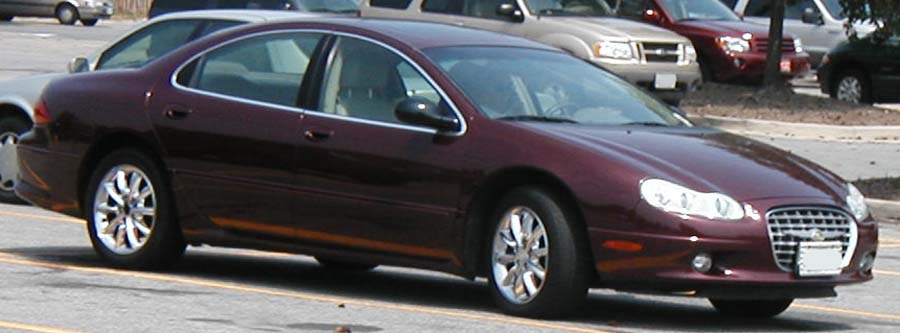
2003 Chrysler Concorde
Recalls, most-reported problems, crash-test ratings, fuel economy and what a 2003 Chrysler Concorde is worth — from official NHTSA and EPA data. 5 on record.

2003 Chrysler Concorde at a glance
Included: that car's specs and build sheet, model-year recall campaigns and a fair price.
2003 Chrysler Concorde recalls 0
No NHTSA safety-recall campaigns are on record for the 2003 Chrysler Concorde.
Source: U.S. NHTSA, checked 4 Nov 2026. A campaign covers the model year; to see whether a particular car still needs the repair, check its VIN on NHTSA.gov or ask a franchised dealer.
2003 Chrysler Concorde common problems
The most-reported problem areas across all 27 owner complaints filed with NHTSA — and what to check before you buy.
2003 Chrysler Concorde safety ratings
Source: NHTSA 5-Star Safety Ratings (NCAP), tested as the 2003 Chrysler Concorde 4-DR.. Ratings can differ by body style and drivetrain.
2003 Chrysler Concorde MPG & running costs
Source: U.S. EPA / DOE fueleconomy.gov. The EPA lists 2 versions of this model year; combined is shown as a range and the other figures are averages.
Estimated 5-year cost to own
A rough guide to what running a 2003 Chrysler Concorde costs over five years and 75,000 miles.
How this is estimated: fuel is the U.S. EPA annual cost at 15,000 miles a year. There aren't enough comparable listings to estimate depreciation for this model, so it is left out. Not included: insurance, maintenance, repairs, taxes, registration and finance costs. Treat it as a comparison guide, not a quote.
Dimensions & weight
Manufacturer-reported figures for the 2003 Chrysler Concorde — ranges cover the 2 body / drivetrain versions on record. Source: Transport Canada vehicle specifications via NHTSA.
Investigations & service bulletins
NHTSA defect investigations 1
THROTTLE CONTROL FAILURE Closed
BASED ON THE LOW FAILURE RATE, THE ABSENCE OF FAILURES OVER THE PAST YEAR, THE ABSENCE OF INJURIES, AND ODI'S FIELD INVESTIGATION OF INCIDENT VEHICLES, A SAFETY-RELATED DEFECT TREND HAS NOT BEEN IDENTIFIED AT THIS TIME. ACCORDINGLY, THIS INVESTIGATION IS CLOSED. THE CLOSING OF THIS INVESTIGATION DOES NOT CONSTITUTE A FINDING BY NHTSA THAT NO SAFETY-RELATED DEFECT EXISTS. THE AGENCY WILL TAKE FURTHER ACTION IF WARRANT…
NHTSA #PE03010 · Vehicle Speed Control · opened Feb 2003 · closed Sep 2003An investigation means NHTSA is examining a possible defect — it is not a recall, and many close without one.
Manufacturer service bulletins 67
Technical notes the manufacturer sent to dealers about known issues and fixes. Useful to mention to a mechanic — they are not recalls and repairs may not be covered. Showing the 10 most recent of 67.
KEY, Master If replacing the key/FOBIK on a WJ, KJ, TJ, or PT Cruiser, use the "AC" NIC level part number. The "AB" NIC level will not program to these platforms. For all other platforms, if the "AB" NIC level will not program to the vehicle, use the "AC" NIC…
Bulletin 9004275 · Electrical System · Jul 2020KEY, Master If replacing the key/FOBIK on a WJ, KJ, TJ, or PT Cruiser, use the "AC" NIC level part number. The "AB" NIC level will not program to these platforms. For all other platforms, if the "AB" NIC level will not program to the vehicle, use the "AC" NIC…
Bulletin 9004275 · Electrical System · Jul 2020Disinfectant Solution Recommended for COVID-19
Bulletin 23-015-20 · Equipment, Structure · Apr 2020Charging System, Battery Diagnostic Tools and Warranty This information only bulletin discusses using the correct test equipment for testing batteries and charging systems, and also warranty reimbursement when battery replacements are necessary.
Bulletin 08-049-20 · Electrical System, Equipment · Apr 2020Use of Salvage/Recycled Parts This bulletin involves discussing FCA US LLC position with regard to collision repair industry awareness regarding the use of recycled or salvage parts.
Bulletin 31-003-19 · Equipment · Nov 2019Use of Aftermarket Parts This bulletin involves discussing FCA US LLC position with regard to collision repair industry awareness regarding the use of aftermarket parts.
Bulletin 31-005-19 · Structure, Equipment · Nov 2019Use of Aftermarket Parts This bulletin involves discussing FCA US LLC position with regard to collision repair industry awareness regarding the use of aftermarket parts.
Bulletin 3100519 · Structure · Nov 2019Repair Parts Used For Structural Repairs This bulletin involves discussing FCA US LLC position with regard to structural repair parts usage.
Bulletin 3100619 · Structure, Equipment · Nov 2019Use of Salvage/Recycled Parts This bulletin involves discussing FCA US LLC position with regard to collision repair industry awareness regarding the use of recycled or salvage parts.
Bulletin 3100319 · Structure · Nov 2019Repair Parts Used For Structural Repairs This bulletin involves discussing FCA US LLC position with regard to structural repair parts usage.
Bulletin 31-006-19 · Structure · Nov 2019Source: NHTSA Office of Defects Investigation, listed for the CONCORDE. Model-year data, not specific to one car.
About the Chrysler Concorde
The Chrysler Concorde is a full-size car that was produced by Chrysler from 1992 to 2004. It assumed the C-body Chrysler New Yorker Salon's position as the entry-level full-size sedan in the Chrysler brand lineup. One of Chrysler's three original Chrysler LH platform models, it has a front-engine, front-wheel-drive layout.
From Wikipedia, licensed CC BY-SA 4.0. Describes the model line in general, not this model year specifically.