2018 Toyota Corolla
Recalls, most-reported problems, crash-test ratings, fuel economy and what a 2018 Toyota Corolla is worth — from official NHTSA and EPA data. 907 on record.

2018 Toyota Corolla at a glance
Included: that car's specs and build sheet, model-year recall campaigns and a fair price.
2018 Toyota Corolla recalls 3
Toyota Motor Engineering & Manufacturing (Toyota) is recalling certain 2011-2019 Corolla, 2011-2013 Matrix, 2012-2018 Avalon, and 2013-2018 Avalon Hybrid vehicles. During certain crashes, the air bag electronic control unit (ECU) may malfunction, possibly disabling the deployment of the air bags and/or seat belt pretensioners.
Fix: Toyota will notify owners, and dealers will inspect the ECU and install a noise filter between the air bag control module and its wire harness, as necessary, free of charge. Owners were notified of the safety risk beginning March 2, 2020. A second letter notifying owners of the remedy repair will b…
Toyota Motor Engineering & Manufacturing (Toyota) recalled certain 2018-2019 4Runner, Highlander, Camry, Land Cruiser, Sequoia, Sienna, Tacoma and Tundra, and Lexus RC 300, RC 350, GS 350, GX 460, IS 300, LC 500, LS 500, LX 570, RX 350L, and 2019 Toyota Avalon and Corolla, and certain Lexus NX 300, and ES 350 vehicles on January 13, 2020. On March 4, 2020, Toyota expanded the recall to include certain 2014-2015 Toyo…
Fix: Toyota will notify owners, and dealers will replace the fuel pump, free of charge. The recall began May 4, 2020. Owners may contact Toyota customer service at 1-888-270-9371 or Lexus customer service at 1-800-255-3987. Toyota's numbers for this recall are 20TB02 and 20TA02 for Toyota vehicles and 2…
Southeast Toyota Distributors, LLC (SET) is recalling certain 2017-2019 Toyota Camry, Corolla, Rav4, Sienna, and Yaris iA vehicles equipped with factory-installed floor mats. The load carrying capacity modification label may be incorrect. As such, these vehicles fail to comply with the requirements of Federal Motor Vehicle Safety Standard (FMVSS) number 110, "Tire Selection and Rims."
Fix: SET will notify owners and provide a corrected label for placement over the inaccurate label, free of charge. The recall began August 23, 2019. Owners may contact Toyota customer service at 1-888-270-9371. SET's number for this recall is SET19A.
Source: U.S. NHTSA, checked 4 Nov 2026. A campaign covers the model year; to see whether a particular car still needs the repair, check its VIN on NHTSA.gov or ask a franchised dealer.
2018 Toyota Corolla common problems
The most-reported problem areas across all 134 owner complaints filed with NHTSA — and what to check before you buy.
2018 Toyota Corolla safety ratings
Rollover risk: 11.8% — NHTSA's estimated chance of rollover in a single-vehicle crash (dynamic test: no tip).
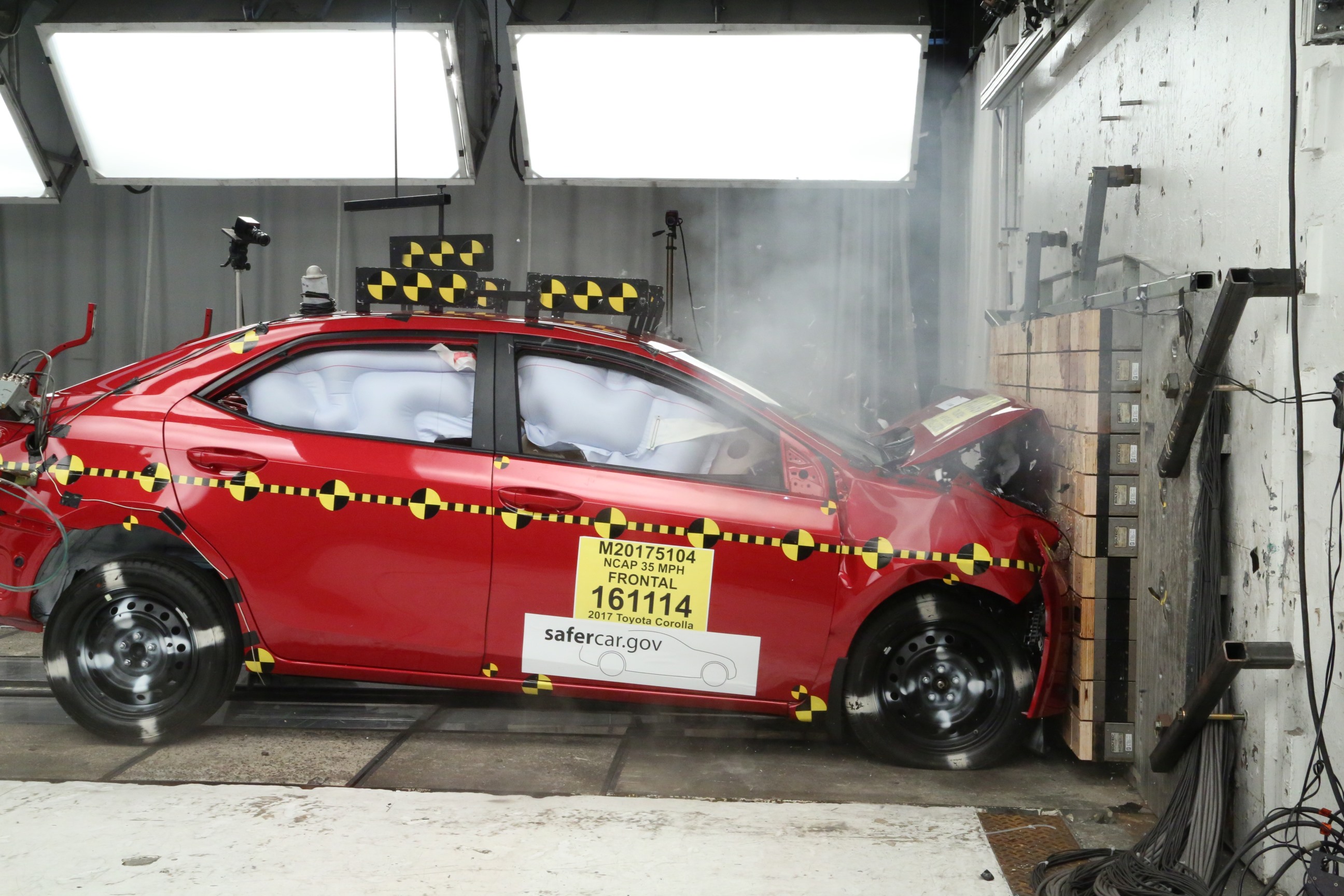


Source: NHTSA 5-Star Safety Ratings (NCAP), tested as the 2018 Toyota Corolla 4 DR FWD. Ratings can differ by body style and drivetrain.
2018 Toyota Corolla MPG & running costs
Source: U.S. EPA / DOE fueleconomy.gov. The EPA lists 3 versions of this model year; combined is shown as a range and the other figures are averages.
What's a 2018 Toyota Corolla worth?
Estimated 5-year cost to own
A rough guide to what running a 2018 Toyota Corolla costs over five years and 75,000 miles.
How this is estimated: fuel is the U.S. EPA annual cost at 15,000 miles a year. Depreciation compares today's typical asking price for this model year ($16,532) with the same model 5 model-years older ($11,364), from CarLogs listing data. Not included: insurance, maintenance, repairs, taxes, registration and finance costs. Treat it as a comparison guide, not a quote.
Dimensions & weight
Manufacturer-reported figures for the 2018 Toyota Corolla — ranges cover the 2 body / drivetrain versions on record. Source: Transport Canada vehicle specifications via NHTSA.
Investigations & service bulletins
NHTSA defect investigations 2
Desiccated Air Bag Inflator Rupture Open
From 2000 through 2017, Takata produced millions of air bag inflators using two types of phase-stabilized ammonium nitrate ("PSAN") propellant -- propellant 2004 and propellant 2004L. After prolonged exposure to high temperature cycles and humidity, inflators using propellant 2004 can degrade, causing the propellant to burn too quickly when ignited. The rapid burning can cause the inflator to rupture during deploymen…
NHTSA #EA21002 · Air Bags · opened Sep 2021Electrical overstress Closed
The Office of Defects Investigation (ODI) opened this investigation to determine if the failure of airbags to deploy during severe crashes, in certain vehicles, was the result of a safety related defect. During the investigation a complex failure was studied that can result in non-deployment of subject vehicle air bags and other restraint system devices in severe crash events. The subject vehicles may be equipped wi…
NHTSA #EA19001 · Air Bags · opened Apr 2019 · closed Sep 2024An investigation means NHTSA is examining a possible defect — it is not a recall, and many close without one.
Manufacturer service bulletins 183
Technical notes the manufacturer sent to dealers about known issues and fixes. Useful to mention to a mechanic — they are not recalls and repairs may not be covered. Showing the 10 most recent of 183.
Some 2005 – 2026 Toyota vehicles that have undergone water intrusion may exhibit a condition in which a musty odor is present. Follow the procedures in this bulletin to remediate the odor and address this condition. The purpose of this Service Bulletin is to p…
Bulletin T-SB-0055-24 Rev2 · Jan 2026The air conditioning dye injection tool kit has been developed to aid in identifying the location of air conditioning refrigerant leaks. The procedures outlined in this Service Bulletin aid in locating, inspecting, and repairing refrigerant leaks.
Bulletin T-SB-0058-23 Rev1 · Electrical System · Jun 2025Acid rain results from rainwater or other airborne moisture that become acidic due to industrial chemical impurities in the atmosphere. If these acidic compounds settle on an exposed vehicle, especially the horizontal areas such as the hood, roof, and decklid,…
Bulletin T-SB-0035-24 Rev2 · Structure · Dec 2024To prevent brake rotor rust from forming during transportation and storage, wheel film will be used instead of a cardboard type of anti-rust cover. The purpose of the wheel film is to shield the disc brake rotor from weather elements and initial rust before th…
Bulletin T-SB-0038-24 Rev2 · Structure · Dec 2024The condition known as acid rain is caused by airborne chemicals or particles in the atmosphere, which mix with rainwater, nighttime dew, or high humidity to form acidic compounds. If these contaminants settle and remain on a painted vehicle surface, especiall…
Bulletin T-SB-0039-24 Rev2 · Structure · Dec 2024Toyota vehicles are currently protected with RapgardTM protective film designed to protect the horizontal painted surfaces. This material protects from acid rain, environmental fallout, and rail contamination. Follow the Removal Procedure in this bulletin to r…
Bulletin T-SB-0061-23 Rev2 · Structure · Dec 2024Vehicles may occasionally be subjected to contamination by airborne iron particles shed from railroad tracks, train wheels, exposure to heavy machinery facilities, grinding, welding, etc. This type of contamination can be identified by the presence of small, r…
Bulletin T-SB-0062-23 Rev2 · Structure · Dec 2024Some 2005 – 2024 Toyota vehicles that have undergone water intrusion may exhibit a condition in which a musty odor is present. Follow the procedures in this bulletin to remediate the odor and address this condition. The purpose of this Service Bulletin is to p…
Bulletin T-SB-0055-24 Rev1 · Structure · Jul 2024Some 2005 – 2024 Toyota vehicles that have undergone water intrusion may exhibit a condition in which a musty odor is present. Follow the procedures in this bulletin to remediate the odor and address this condition. The purpose of this Service Bulletin is to p…
Bulletin T-SB-0055-24 Rev1 · Structure · Jul 2024The condition known as acid rain is caused by airborne chemicals or particles in the atmosphere, which mix with rainwater, nighttime dew, or high humidity to form acidic compounds. If these contaminants settle and remain on a painted vehicle surface, especiall…
Bulletin T-SB-0039-24 Rev1 · Structure · Jul 2024Source: NHTSA Office of Defects Investigation, listed for the COROLLA FWD. Model-year data, not specific to one car.
Canadian recalls 4
Transport Canada recall campaigns for the 2018 Toyota Corolla. Relevant if the car was first sold in, or imported from, Canada.
Electrical
Issue: This recall is for certain block heater kits installed on certain vehicles or sold as accessories at Toyota or Lexus dealerships. On certain vehicles, the engine block heater cable may not have enough heat protection and could be damaged by high temperatures. If this happens, the cable could short circuit while plugged in, and cause the wiring to overheat or melt. Note:…
Transport Canada #2021723 · Nov 2021Fuel System
Issue: On certain vehicles, the low-pressure fuel pump could fail. If this happens, then engine may run rough or may not start and the check engine light may turn on. This could also result in a sudden loss of engine power while driving. Note: This recall is an expansion of recalls SRC R95/SRC R96 and SRC RA2/SRC RA3 (Transport Canada Recall Numbers 2020-005 and 2020-088). Safe…
Transport Canada #2020514 · Oct 2020Fuel System
Issue: On certain vehicles, the low-pressure fuel pump could fail. If this happens, then engine may run rough or may not start and the check engine light may turn on. This could also result in a sudden loss of engine power while driving. Note: This recall is an expansion of recall SRC R95/SRC R96 (Transport Canada Recall No. 2020-005) Safety Risk: A sudden loss of engine power…
Transport Canada #2020088 · Mar 2020Airbag
Issue: On certain vehicles, the circuits within the airbag control module could be damaged in a crash. This could cause the airbags and seat belt pretensioners to not deploy in certain crashes. Safety Risk: Airbags or seat belts that do not work properly in a crash could create an increased risk of injury. Corrective Actions: Toyota will notify owners by mail and instruct you t…
Transport Canada #2020013 · Jan 2020Source: Transport Canada Motor Vehicle Safety Recalls Database.
About the Toyota Corolla
The Toyota Corolla is a series of compact cars manufactured and marketed globally by the Japanese automaker Toyota Motor Corporation since 1966. Since 1997, the Corolla has remained the best-selling automobile nameplate of all time, surpassing the Volkswagen Beetle. Toyota reached the milestone of 50 million Corollas sold over twelve generations in 2021, and has sold over 54 million units as of early 2026.
From Wikipedia, licensed CC BY-SA 4.0. Describes the model line in general, not this model year specifically.
2018 Toyota Corolla trims & engines on record
2018 Toyota Corolla vehicles on record
2018 Toyota Corolla L/LE/SE/XLE/XSE5YFBURHE0JP760826
2018 Toyota Corolla L/LE/SE/XLE/XSE5YFBURHE3JP774493
2018 Toyota Corolla L/LE/SE/XLE/XSE5YFBURHE8JP794836
2018 Toyota Corolla L/LE/SE/XLE/XSE2T1BURHE6JC123195
2018 Toyota Corolla L/LE/SE/XLE/XSE2T1BURHE2JC062685
2018 Toyota Corolla L/LE/SE/XLE/XSE2T1BURHE4JC122837
2018 Toyota Corolla L/LE/SE/XLE/XSE5YFBURHE8JP841945
2018 Toyota Corolla L/LE/SE/XLE/XSE2T1BURHE0JC122009
2018 Toyota Corolla L/LE/SE/XLE/XSE5YFBURHE5JP815318
2018 Toyota Corolla L/LE/SE/XLE/XSE2T1BURHEXJC109669
 2018 Toyota Corolla L/LE/SE/XLE/XSE5YFBURHE7JP829057
2018 Toyota Corolla L/LE/SE/XLE/XSE2T1BURHE7JC056638
2018 Toyota Corolla L/LE/SE/XLE/XSE2T1BURHE9JC096283
2018 Toyota Corolla L/LE/SE/XLE/XSE2T1BURHE6JC001064
2018 Toyota Corolla L/LE/SE/XLE/XSE5YFBURHE1JP745042
2018 Toyota Corolla L/LE/SE/XLE/XSE5YFBURHE7JP828880
2018 Toyota Corolla L/LE/SE/XLE/XSE5YFBURHE3JP809324
2018 Toyota Corolla L/LE/SE/XLE/XSE5YFBURHE2JP796145
2018 Toyota Corolla L/LE/SE/XLE/XSE5YFBURHE4JP808635
2018 Toyota Corolla L/LE/SE/XLE/XSE5YFBURHE2JP807564
2018 Toyota Corolla L/LE/SE/XLE/XSE5YFBURHE0JP804713
2018 Toyota Corolla L/LE/SE/XLE/XSE5YFBURHE9JP830808
2018 Toyota Corolla L/LE/SE/XLE/XSE5YFBURHE5JP855284
2018 Toyota Corolla L/LE/SE/XLE/XSE5YFBURHE2JP832089